
Vinyl · fiberglass · aluminium
Every Milgard line we carry, and who each one is actually for.
Seven series, three frame materials, and the manufacturer catalogs to download. Pick the material first and the series choice mostly makes itself.
Authorized dealer


Start with the frame material, not the series name
Milgard’s line-up looks more complicated than it is. There are three frame materials — vinyl, fiberglass and aluminium — and the series names sit underneath those. Pick the material that suits your house and exposure first, and the series choice mostly makes itself.
Vinyl insulates well and costs the least, and it is the right answer for most West Valley houses. Fiberglass barely expands in heat, so it holds a dark exterior colour and handles oversized openings without bowing. Aluminium is the narrowest frame and the strongest, but it conducts heat, which matters a great deal on a west elevation and is why California’s energy code treats it carefully.
The vinyl lines
Style Line, the V250, is the value line: narrow frames, more glass for the same opening, and a flush fin that retrofits over an existing aluminium frame without touching your stucco. It is the most common thing we install.
Trinsic, the V300, is the thinnest vinyl frame Milgard makes. Choose it where the view is the point — hillside lots, rear elevations, anywhere the frame is competing with what is behind it.
Tuscany, the V400, has a heavier beveled frame, better hardware, and the widest choice of shapes and grid patterns, which is why it usually ends up on the street-facing side of the house.
Fiberglass and aluminium
C700 Series is painted fiberglass — the line Milgard used to call Ultra. It is the line to pick for a dark exterior colour in Valley heat, for very large openings, and for a full-house replacement you intend to keep rather than resell.
A250 Thermally Improved Aluminum gives you the narrowest sightlines and the biggest spans. It is also the frame most houses here are replacing rather than buying, and there is a real energy-code reason for that — worth reading before you specify it.
Specialist lines
Quiet Line is built for sound rather than heat: laminated glass and a heavier assembly for houses under a flight path, near the 101, or on a busy street.
Moving Glass Walls are the multi-panel doors that stack or pocket into the wall. These usually involve structural work, and we will tell you that before you fall in love with the idea.
Patio doors run across several of these lines — sliding, French swinging and the multi-panel systems. There is a separate page on patio doors covering what fails, when a repair beats a replacement, and which line does what.
We also carry Ply Gem, whose Pro200 series covers a lot of the same ground as Style Line at a similar price point.
What counts as efficient here
Los Angeles sits in the Southern climate zone. To carry the ENERGY STAR v7 label in this zone a window has to hit a U-Factor of 0.32 or lower and a Solar Heat Gain Coefficient of 0.23 or lower, with air leakage no worse than 0.3 cfm/ft². Patio doors with more than half their area in glass are held to 0.28 and 0.23.
Those are the numbers to check any quote against, ours included. For reference, the Trinsic V300 build we quote most often is rated 0.25 and 0.20 — comfortably inside both. Every window ships with those figures printed on an NFRC sticker in the corner, and we leave it there until you have read it.
The catalogs
These are Milgard’s and Ply Gem’s own brochures. They are useful for shapes, grid patterns and colour options, and they are large files — the biggest is over 5 MB, so they are worth opening on wi-fi rather than data.
What they will not tell you is which line suits your specific openings and exposure. That is what the estimate is for, and it is free.
- V250 Style Line (PDF, 1.8 MB)
- V300 Trinsic (PDF, 1.0 MB)
- V400 Tuscany (PDF, 0.9 MB)
- C700 Fiberglass (PDF, 2.1 MB)
- A250 Thermally Improved Aluminum (PDF, 2.0 MB)
- Moving Glass Walls — VX350, AX450, AX650 (PDF, 2.7 MB)
- Energy efficiency and glass options (PDF, 4.8 MB)
- Ply Gem Pro200 Series (PDF, 0.9 MB)
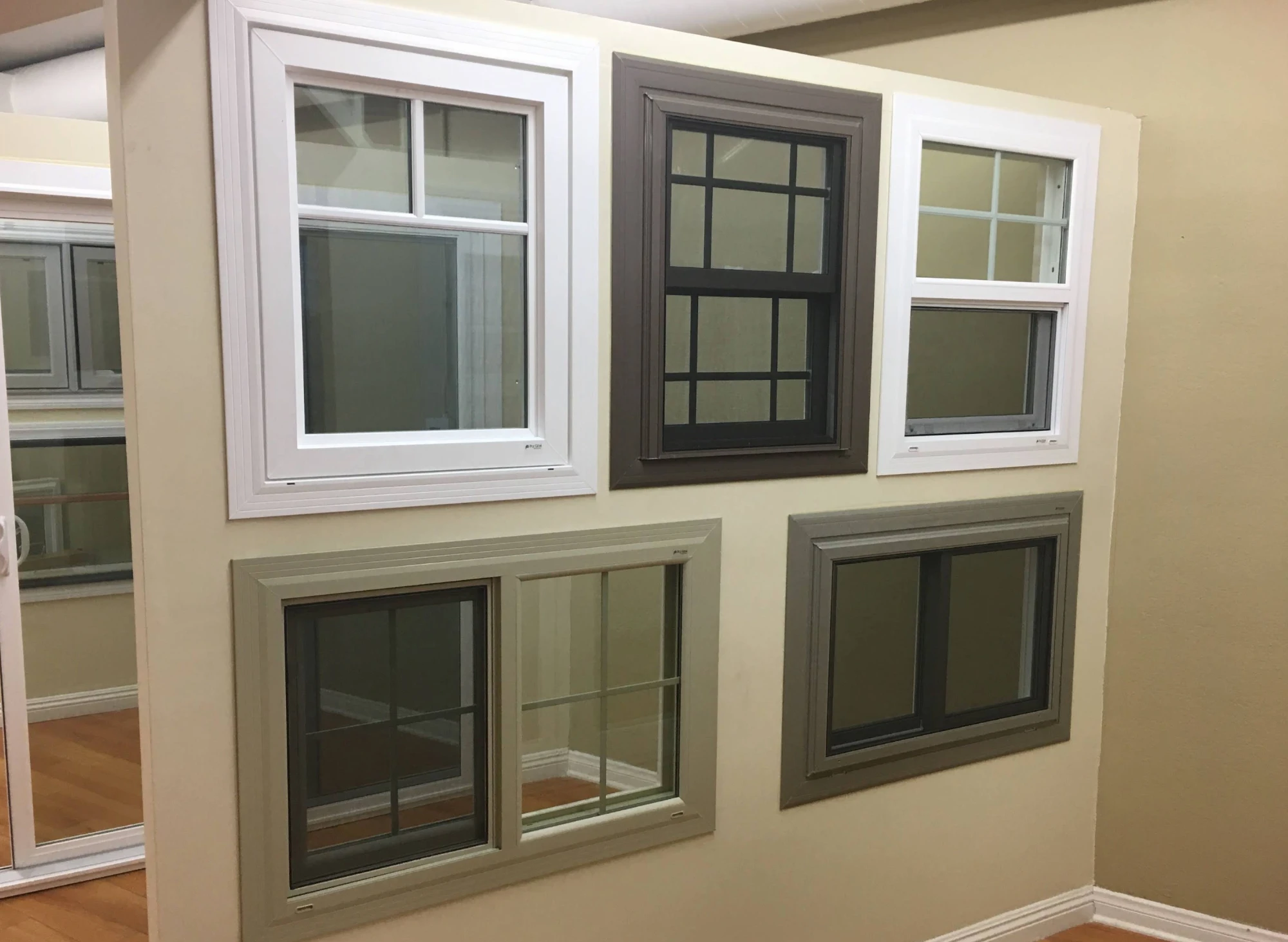
Every line here is available as a retrofit, and we are an authorized Milgard dealer with frames mounted on the floor in Canoga Park.
The ones people actually call about
Questions homeowners ask
Which Milgard series is the best one?
There is no best one, which is why there are seven of them. Style Line for most houses, Trinsic where the view matters more than the frame, Tuscany for shapes and grids on a street-facing elevation, Ultra Series in fiberglass for dark colours and big openings, Quiet Line for noise, Aluminum for narrow sightlines. The right answer depends on your exposure, your openings and your budget.
What is the difference between Trinsic and Tuscany?
Trinsic is the slim-line vinyl frame — less frame, more glass, a contemporary look. Tuscany has a heavier beveled frame with more hardware options and a much wider range of shapes and grid patterns. People generally choose Trinsic for the view and Tuscany for the look from the street.
Do you carry every Milgard line in the showroom?
No showroom carries all of them in every configuration. We keep the common lines mounted in full frames so you can open and lock them. Call before you drive out if there is a specific series you want to see and we will tell you what is standing that week.
Are the brochures current?
They are the manufacturer's published catalogs and they are useful for shapes, grids and colours. Specifications and available options do change, so treat any performance number in a brochure as indicative — your written quote lists the actual NFRC ratings for the units on your order.
Do you carry anything other than Milgard?
Ply Gem, whose Pro200 series covers similar ground to Style Line. We are an authorized dealer for both, plus Simonton. If a line genuinely suits your job better than what we carry, we will say so.
Free, in your home, no fee
Find out what it costs
We measure, price every opening separately, and leave the written quote with you. Whether you call us back is up to you.